
There is a lot of talk about African Americans’ contributions to American history and culture. Let’s set the record straight and say what should be well known: American history was written by the history of slavery, including the slaves resistance to slavery and their quest for human and civil rights. The recollections of those struggles is the only authentic record that the United States contributes to the world of human history. This is also the only authentic and entirely American history. That is, a history that was not borrowed or stolen from another.
When the source of history renders a positive or negative model of the past for the present, historians usually report contributions from antiquity for a useful model of behavior This historical acknowledgement includes a character that impacts events. Subsequently, history reflects times of human engagement with many A’s, B’s, and C’s affecting its outcome. When these measured incidents contribute to humanity in some form or another, historians write a finale. Paradoxically, the history of the American colonies is far afield any major positive contributions to the human quilt except for the discussion of the Transatlantic slave trade. This is because from actual slavery to the emancipation, to reconstruction, and to the last civil rights act, a human presence forged the American nation from a state of ignorance, oppression, and injustice, into a nation that may boast of justice, freedom and equality. Today that nation feigns a global standard to defeat ignorance, oppression, and injustice everywhere; this character evolved in America without military intervention or war, but with stalwart perseverance and courage from the Africans chained as chattel. Whereas today the benefits of this history falls upon the degenerates and the disqualified, the gratuities of this history still avails a wide and diverse global human society, which testifies to the legacy of the African slave and the two generations following who branded American history by their character into the fabric of this country. They did not lose their humanity and succumb to perhaps the most inhuman institution of slavery. Quite the contrary, in every struggle, they reflected and shared their humanity.
At this juncture, I digress.
Recently, my own truths collided with reality. At first, I reaffirmed that institutional and economic slavery has existed from ancient history when the first prisoners of war were captured. I don’t know the date of this first event, but it serves to imagine and justify the evolution of all slavery. Subsequently, it’s logical that these first Prisoners Of War were a liability who, in time, became lucrative assets. Consequently, for economy — every known civilization and empire (like the African tribes) were engaged in some form of slavery. I hoped that the Muslims who owned slaves (en masse) treated their slaves according to the dictums of Quran and the humanity of the Prophet (saws); yet… they did not. And from viewing a YouTube video titled The 10 Tribes of the Transatlantic Slave Trade, I learned that although each and every one of those African tribes reached the Americas as slaves, their tribes — families (mothers, fathers, etc.) were also directly or indirectly “slavers” before, during, and after the Transatlantic trade was documented. Furthermore, a most predominant tribe doing business was the Fulani, Muslims.
After this, and with my firm faith in the greatness of Allah (T’ala), the truth of our American history, plus my own acceptance, informed an excuse for my and my fellow Muslims’ presence as Prisoners of War here without land, without culture, and without known ancestors; we have no other history except slavery, which leaves our identity still a blank page without an identifiable misnomer (for this piece, we reference POW). In this condition, we are present attempting to etch out a place when we have none to garner. Yes, we are here, but not like others who have come. Our past can only be a character study, a window into the conditions that drove us out of Africa and into an alchemy of circumstance — a purge from our past to recreate us — naked then clothed us anew to fulfill some purpose while we are here.
As Muslims in America, we do suffer oppression — indirectly in most cases. The question for me remains — why are we here?

I am convinced Allah ﷻ proscribed this path for us by Allah (ﷻ), and like all others, it is unique to us. We are only Muslims — nothing else. Why? Look back at the character of our forerunners: our mothers, fathers, grandfathers with the microscope of the Quran. You will find the persona of Muhammad (ﷺ) in their actions and aspirations — their life and their death. The subscription divinely aspired for every human being to ascribe: neighborly needs, charity to the poor and the needy, care for the women and orphans; commitment to promises, excellent manners under all circumstances; patience, perseverance — visionaries, and firm faith and hope in the promise of Allah (ﷻ) for the Hereafter with a need to establish justice no matter the cost.
Apparently, the mission is to struggle and sustain good character by “whatever means necessary”, and in whatever circumstance presented — including war!
The progression of American history and world history begins and ends with character. And the explanation for the opening statement that American history is the history of the slaves means that the adaptation to a modicum of humanity in this country metastasized from the interaction between the slaves and the slave owner. I propose the audience peer into the past and inside the rustic slave quarters, or walk into the big house. What will you view? Manners. There was always a way “things were done”. But it was not the way the “white folks” did things. No, the “white folks” learned how to do from the slaves.
They learned how to help the slaves get freedom from Harriet Tubman. They learned how to run plantations from a slave named Baily. They learned how to take care of children from the woman called “Mammy”. They learned perseverance and how to manage struggle from watching the strikes cross the slaves back and him cringing without tears. They learned to be good to the neighbor even though the neighbor wasn’t good to them. They learned patience and restraint from the repeated rapes without rebuke from the victims’ husbands or the victim. They learned to respect women from the strength of the slave women. They learned how to resist and fight for the freedom to exist as humans, regardless of the battle that had to be fought. (Slaves fought every war the colonist fought even though they were slaves). They learned much more in character from the slaves. By default, the slaves maintained a high standard of character because they were always under threat of brutal punishments. To think and not react, to wait, and not respond, to pray and not lose hope was branded into the slaves’ hearts by virtue of their circumstance. Would they have adopted these manners without chattel slavery, or would they have remained in Africa and been of those who raided villages and traded slaves sending their kinsmen and women to America and oppression? Allah (ﷻ) knows best. No matter, it was this mode of survival that highlighted their character attributes, which subsequently changed the inhumane environment of Jim Crow to human and civil rights decades after.
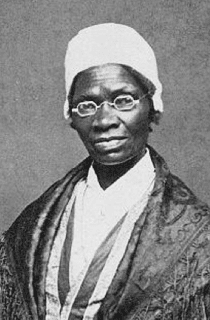
Sojourner Truth, born in America but whose origins were from Guinea, West Africa, said: “I don’t align with Black folks, I align with whites because maybe if they see my humanity, they will be human too.”
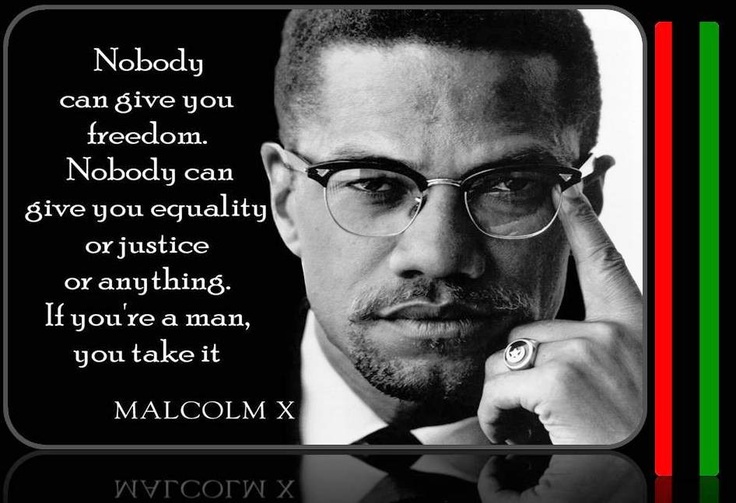
That same statement came from El Hajj Malik Shabazz, who said something similar when he returned from Hajj: “Maybe if the white people see Islam, they might become human too.”
 Islamic Treatise